When you click on links to various merchants on this site and make a purchase, this can result in this site earning a commission. Affiliate programs and affiliations include, but are not limited to, the eBay Partner Network.
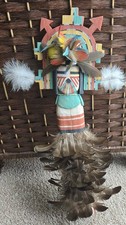
This impressive figure measures approximately 20 inches tall and features a large geometric headdress painted in turquoise/green, red, yellow, black and natural tones. The face and body are decorated with detailed traditional-style geometric designs.
One of the most striking features is the extensive feather work. The lower portion is covered with layers of genuine brown feathers, many displaying a beautiful green/bronze iridescent sheen depending on the angle and lighting. Additional brown, white and brightly colored feathers decorate the face and headdress.
The figure is signed “T. Huma” and marked “HOPI TEWA” on the reverse of the carved wood. Please see close-up photographs of the artist\'s signature and construction.
Details:
Artist: T. Huma
Marked: HOPI TEWA
Katsina/Kachina doll
Hand-carved wood
Hand painted
Extensive genuine feather decoration
Layered iridescent brown/green feathers
Multicolored feather headdress
White feather side plumes
Approximately 20\" tall
Approximately 6\" wide across the lower feathered section
Signed on reverse
Southwestern / Pueblo collectible art
Condition: Pre-owned with age-related wear to the painted wood and feathers. Feathers naturally show some bending, separation, unevenness and wear. There may be minor feather loss consistent with age and the delicate nature of the materials. Paint shows areas of rubbing and surface wear. Please enlarge and review all photographs for the best representation of condition.
An unusual and highly decorative T. Huma Hopi Tewa feathered Katsina with wonderful color, texture and presence. The extensive feather work makes this a particularly striking display piece.
Please note: The individual bird species represented by the feathers have not been independently verified, so no specific feather species is being represented as certain. Artist/cultural attribution is based on the “T. Huma / HOPI TEWA” markings present on the piece.