When you click on links to various merchants on this site and make a purchase, this can result in this site earning a commission. Affiliate programs and affiliations include, but are not limited to, the eBay Partner Network.
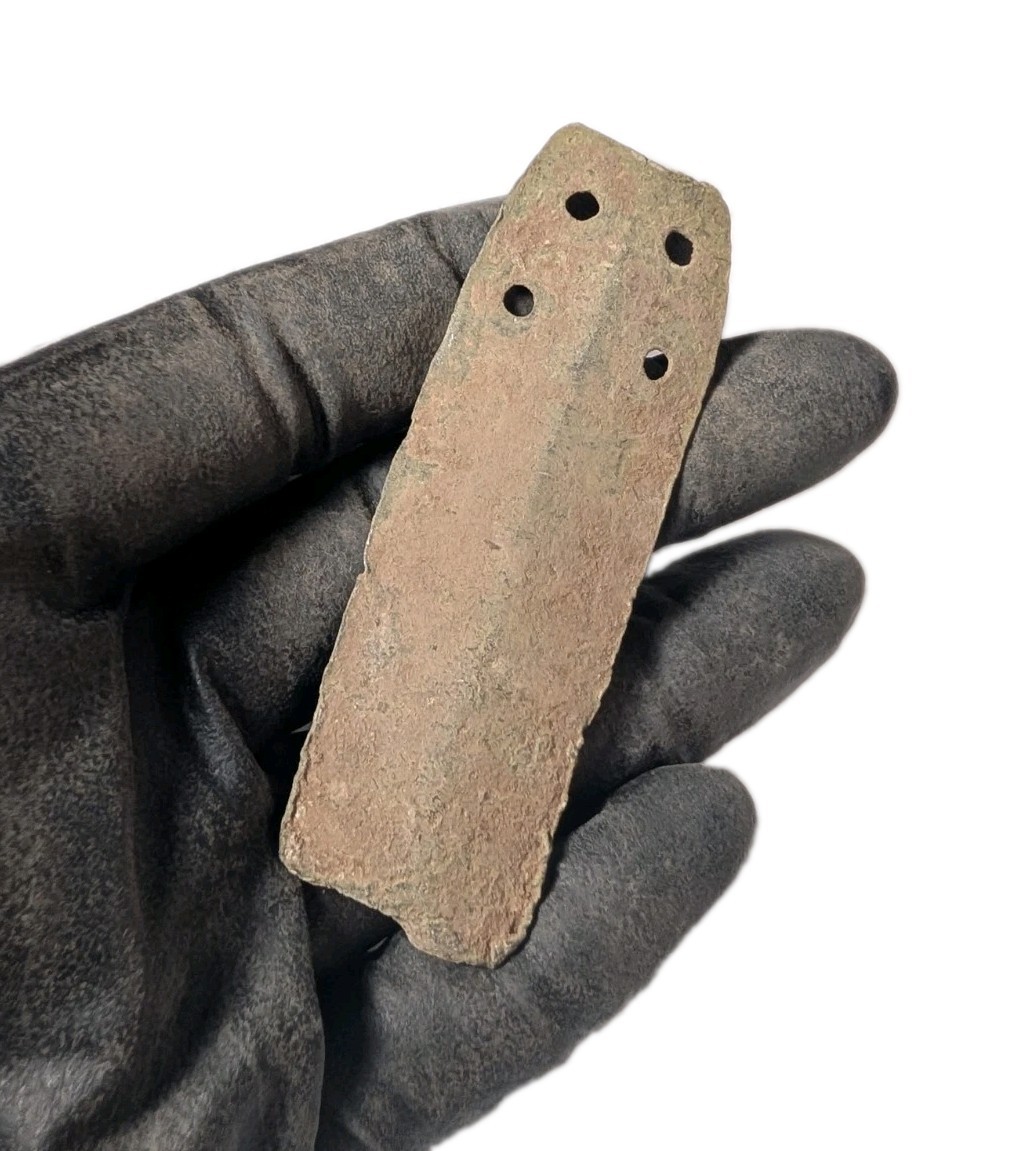
Ancient Canaanite Middle Bronze Age Riveted Dagger Heel / Blade Fragment (~10 cm)
Authenticity & Guarantee
Item Specifications
Object: Cast Bronze Dagger Heel / Riveted Tang Blade Fragment
Culture / Period: Middle Bronze Age I–II (Canaanite / Ancient Levant)
Date Range: Circa 2000 BC – 1650 BC
Dimensions: ~9.0 cm – 10.5 cm length (Heavy Cast Tang with 4 Pierced Rivet Holes)
Material: Heavy Cast Bronze (Copper Alloy)
Form & Architecture: Tapering trapezoidal heel featuring a pronounced central architectural midrib flanked by four clean, hot-punched rivet holes (two pairs) engineered to pin bone, wood, or other handle scales securely to the bronze tang; blade body tapers downward from the hilt junction
Condition: Exceptional archaeological preservation. All four rivet holes complete and uncracked, prominent midrib structure preserved under a heavy desert-tan, sand-gold, and reddish-cuprite mineral patina with malachite undertones.
Historical Context & Middle Bronze Age Armaments
Canaanite Four-Rivet Dagger Engineering
During the Middle Bronze Age (c. 2000–1650 BC), Levantine bronze smiths developed sophisticated riveted daggers (dirks) that served as primary sidearms for Canaanite warriors and officers. The presence of four symmetry-punched rivet holes at the squared tang allowed organic handle plates (crafted from cattle bone, cedar, or hippopotamus bome) to be locked onto the bronze spine with copper pins, absorbing heavy impact shock during close-quarters combat (Ref: Kenyon, Armor and Weapons in Bronze Age Palestine, Levant, 1969; Philip, Metal Weapons of the Early and Middle Bronze Ages in Syria-Palestine, BAR International Series, 1989).
Tactical Midrib Architecture
The raised central ridge running down the length of the blade provided maximum longitudinal rigidity, preventing the cast bronze alloy from bending under thrusting pressure. Weapon fragments featuring intact four-hole tang architecture are prized study pieces representing early Near Eastern metallurgy.
Typological Analysis & Exact Classification
Exact Typological Classification
Comparable Archaeological Examples & Museum Accession Numbers
Israel Museum, Jerusalem (IAA Collection): Middle Bronze Age four-rivet bronze dagger blades from Jericho warrior tombs.
British Museum (Accession No. 1969,0212.1): Canaanite bronze dagger tang with four rivet holes, c. 1800 BC.
A2