When you click on links to various merchants on this site and make a purchase, this can result in this site earning a commission. Affiliate programs and affiliations include, but are not limited to, the eBay Partner Network.
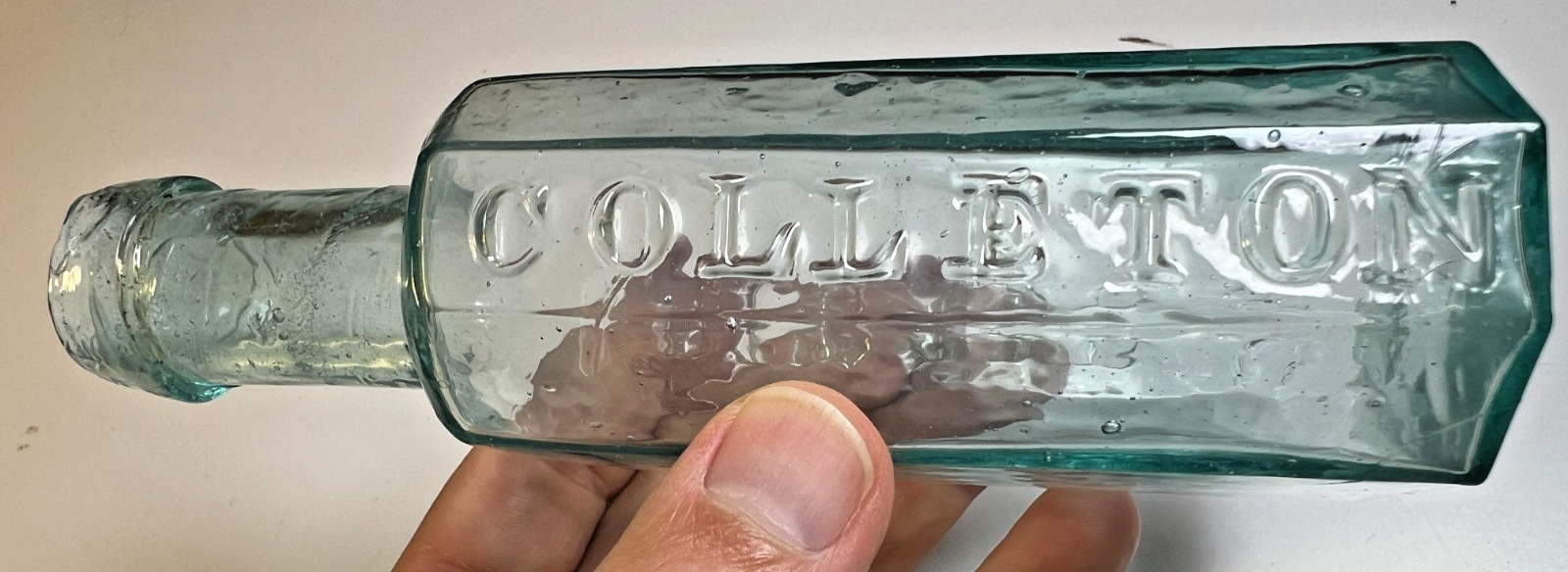
This is far more than an early pontiled medicine bottle—it is a tangible piece of Southern commercial and medical history. Boldly embossed COLLETON / BITTERS, it represents one of the earliest documented proprietary bitters preparations associated with South Carolina and the bustling port city of Charleston.
Produced approximately circa 1846–1850, this bottle survives from an era when medicines were compounded from closely guarded mixtures of herbs, roots, bark, spices, and alcohol—and advertised with promises of relief from nearly every complaint imaginable.
Mrs. Emily A. Jenkins’ Colleton Bitters
Period newspaper advertisements identify the preparation as Mrs. Emily A. Jenkins’ Colleton Bitters, originating in Colleton District, South Carolina, south of Charleston.
The bitters were promoted as a “purely vegetable compound” and advertised for digestive complaints including dyspepsia and acidity of the stomach. Testimonials also described the preparation being administered for other illnesses in the broad, optimistic language typical of nineteenth-century patent medicine advertising.
Most significantly, advertisements appearing in 1846 explained that genuine bottles were specially procured with “Colleton Bitters” molded into them. They were reportedly numbered, sealed, and stamped with an appropriate motto to help distinguish the authentic preparation from competing imitations.
That unusual contemporary reference gives the bottle’s embossing exceptional historical importance: the raised lettering was not simply decoration—it was part of the maker’s early system for establishing authenticity and protecting the product’s reputation.
The advertised price was $1 per bottle, a considerable expenditure for an ordinary household in 1846.
Charleston and American Life in the 1840s
When this bottle was made, Charleston was one of America’s most active and influential port cities. Its crowded wharves received ships carrying coffee, spices, fabrics, wine, hardware, medicines, and luxury goods from distant ports.
There were no modern pharmacies, standardized prescriptions, or federal regulations governing proprietary remedies. A person suffering from indigestion, fever, weakness, or a persistent “nervous complaint” might consult a physician—but could just as readily walk into an apothecary or general store and select a bottle based upon a newspaper advertisement or glowing testimonial.
This bottle would have stood on a shelf among hand-labeled tinctures, sarsaparillas, cordials, liniments, and imported remedies. Its boldly molded name assured buyers that they were receiving the genuine Colleton preparation associated with Mrs. Jenkins—not one of the imitations that followed successful medicines.
Spectacular Early Glass Character
The bottle is rectangular with four broad beveled corners, producing an attractive eight-sided appearance. Its brilliant aqua glass is loaded with unmistakable evidence of early hand manufacture.
- Bold COLLETON embossing on one side panel
- Bold BITTERS embossing on the opposite panel
- Strong, easily readable lettering
- Deep open pontil scar
- Crude applied tapered lip
- Abundant whittle and surface texture
- Wavy annealing lines throughout the body
- Pronounced twist lines through the neck
- Numerous seed, fisheye, and elongated air bubbles
- Heavy concentration of bubbles around the neck and applied lip
- Wonderful irregularities created during hand finishing
The neck and mouth are especially impressive. Their swirling lines, bubbles, uneven surfaces, and wonderfully crude applied construction give the glass tremendous movement in the light. No two angles look quite the same.
This is precisely the kind of bold, primitive character collectors seek in an important early bottle.
Dimensions and Construction
- Height: Approximately 6 inches
- Color: Aqua
- Form: Rectangular with four broad beveled corners
- Base: Open pontil
- Lip: Crude applied tapered lip
- Embossing: COLLETON / BITTERS on opposing side panels
- Date: Approximately 1846–1850
- Association: Colleton District and Charleston, South Carolina
Excellent Condition
An exceptionally attractive and display-ready example.
- No chips
- No cracks
- No structural damage
- No remaining haze
- Strong embossing
- Bright, clean, and shiny
- Professionally tumbled to remove light haze
The professional cleaning has allowed the bottle’s beautiful aqua color, abundant bubbles, neck twist, annealing lines, and whittled texture to show clearly. Its early manufacturing character remains wonderfully pronounced.
Considering its approximately 175–180 years of age, this bottle presents exceptionally well.
Why This Example Stands Apart
Early Southern bottles are considerably more difficult to obtain than comparable Northern medicines. This example combines nearly everything an advanced collector could want:
- Documented 1846 newspaper advertising
- Association with a named female proprietor
- Desirable Charleston and South Carolina history
- Genuine open-pontil construction
- Crude applied mouth
- Bold proprietary embossing
- Brilliant aqua color
- Exceptionally bubbly and animated glass
- Excellent damage-free condition
The historical record even describes the specially embossed bottles used to distribute the genuine preparation—creating an unusually direct connection between the surviving artifact and its original advertising.
A rare opportunity for the advanced collector of Southern bottles, Charleston history, pontiled medicines, early bitters, patent remedies, or nineteenth-century American glass.
Please examine all photographs carefully, as they are an important part of the description.