When you click on links to various merchants on this site and make a purchase, this can result in this site earning a commission. Affiliate programs and affiliations include, but are not limited to, the eBay Partner Network.
# Vintage Lambrecht's Mince Meat Label — Lambrecht Creamery, New York & New Jersey, 1910s–1930s 🏷️
---
There is something quietly captivating about a label this plain. No illustration, no decorative border art, no lithographed harvest scene. Just clean, confident typography on a cream-colored ground — the kind of restraint that tells you this company knew exactly who it was. Lambrecht's Mince Meat. Distributed by Lambrecht Creamery. New York. New Jersey. Done. 🖤
This is New Old Stock — a surviving original paper label from the Lambrecht Creamery's East Coast distribution network, produced somewhere in the operational window of the 1910s through the 1930s. It has never been applied to a jar. For a paper label of this age, that is a genuinely remarkable thing. 🕰️
---
**The Label Itself**
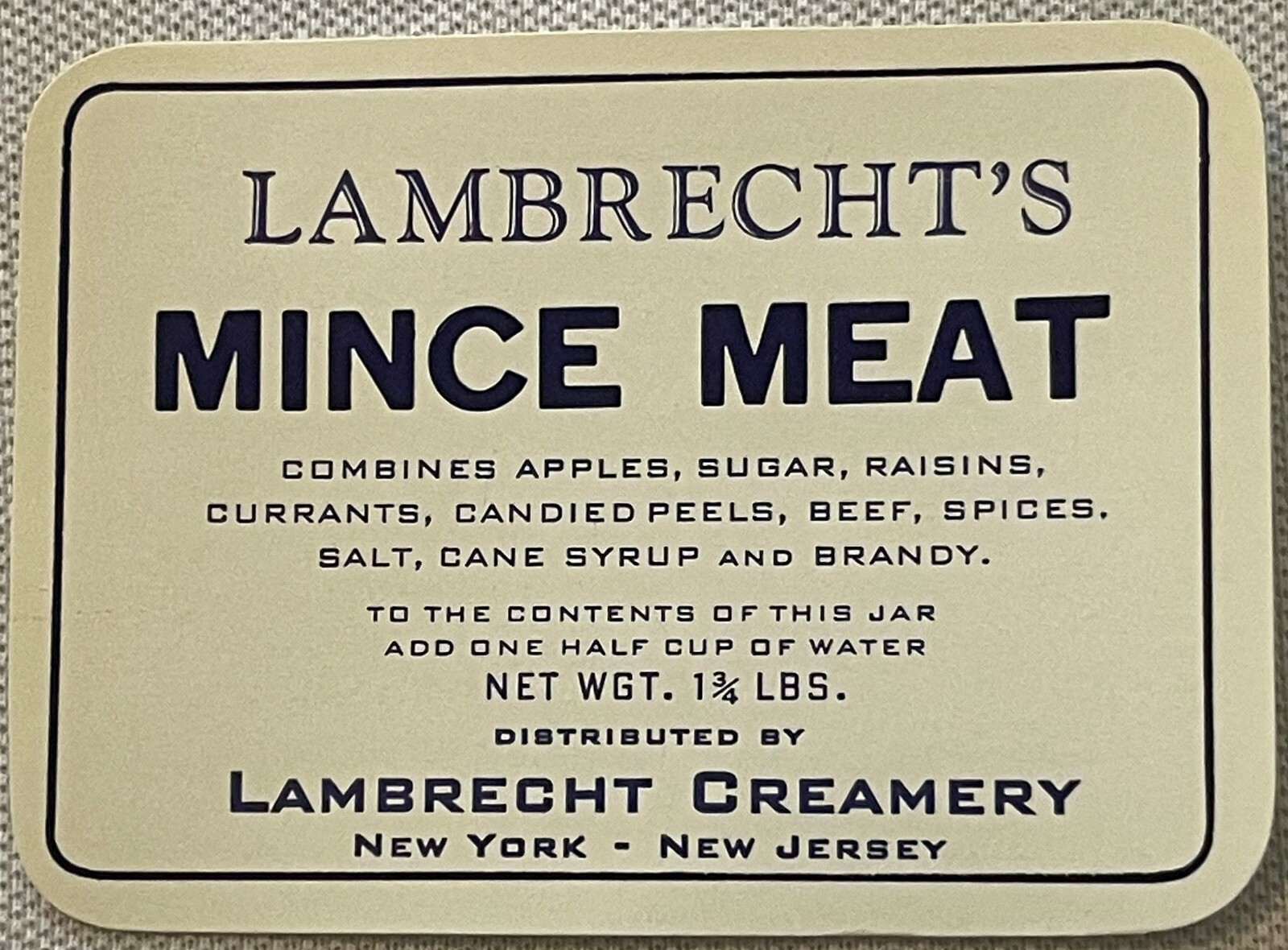
The format is compact — approximately 3 inches wide by 2¼ inches tall, sized to wrap a standard pantry jar of the era. The background is a warm cream, nearly bone-white, with all text printed in a deep navy that reads almost black. A clean single-rule border traces the rounded-corner rectangle edge to edge.
The brand name appears at the top in a dignified serif: LAMBRECHT'S. Below it, in much larger and heavier display type, the product name announces itself with real authority: MINCE MEAT. The size contrast between those two lines gives the label its visual structure — the brand name deferential, the product name bold as a store-window sign. 🪟
Below that, in a smaller and more workmanlike roman face, the full ingredient list reads exactly as a home cook of the era would have wanted to see it: apples, sugar, raisins, currants, candied peels, beef, spices, salt, cane syrup, and brandy. Preparation instructions follow — add one half cup of water to the contents of the jar — and then the net weight: 1¾ lbs. At the base of the label, the distributor identification closes it out. LAMBRECHT CREAMERY. NEW YORK — NEW JERSEY.
Every word that needed to be there is there. Nothing that didn't need to be there made the cut. That is old-school American commercial design at its most honest. ✍️
---
**Lambrecht Creamery: What We Know and What Has Been Lost**
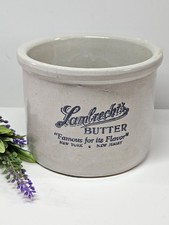
Lambrecht Creamery — the name printed at the foot of this label — operated primarily out of the Midwest; Milwaukee and Chicago carry the bulk of the surviving Lambrecht material. The company was by reputation a dairy and butter operation first, and the mince meat label is a documented product extension under the same name, a practice common among regional food distributors of the era who moved across category lines whenever a market gap presented itself. 🧈
The New York and New Jersey designation is where it gets interesting. The East Coast distribution network is generally associated with Lambrecht's expansion years — the late 1920s and into the 1930s — which places these NY/NJ labels in a narrower production window than the company's overall operational span. The New York–New Jersey line belongs to the company\'s later reach, east of the Midwest where most surviving Lambrecht pieces were branded. The label you are looking at is a documented piece of that East Coast chapter. 🗽
Beyond those facts, the Lambrecht Creamery story goes genuinely quiet. No founder's name has surfaced in surviving primary sources. No dissolution date has been confirmed. No corporate parent has been identified. The company built enough of a distribution footprint to cover two of the most densely populated states in the country, served the New York and New Jersey markets through at least part of the Depression era, and then disappeared from the record. That silence is its own kind of historical texture. 🌫️
---
**The Brandy in the Recipe — and What That Meant in America**
Here is where the lore earns its keep. 🥃
The ingredient list on this label includes brandy, printed plainly among the apples and raisins and beef suet as though there were nothing remarkable about it at all. And in the context of mincemeat, there wasn't — brandy had been part of the traditional recipe since at least the 18th century, serving both as a preservative and as the flavor backbone of the finished pie filling. The old recipes didn't apologize for it.
But this label was almost certainly in production during, or immediately bracketing, Prohibition — the years between 1920 and 1933 when the manufacture, sale, and transportation of intoxicating liquors was constitutionally prohibited across the United States. And that is where mincemeat occupies a genuinely peculiar chapter in American food history. 🇺🇸
What the label itself shows is that Lambrecht listed BRANDY openly among the ingredients, in the same plain type as the apples and the beef. The legal exemptions for fruit preserves and cooking preparations were not always cleanly drawn, and mincemeat, which had always contained alcohol as a functional ingredient, occupied a position that prosecutors and enforcement agents found difficult to attack outright. You weren't selling liquor. You were selling a jar of pie filling. That it happened to contain brandy — enough brandy to make a holiday pie that would warm a dining room considerably past what the crust alone could manage — was, legally speaking, a matter of culinary tradition.
Prohibition ran from 1920 to 1933, and this label\'s window overlaps it. Whether that mattered to how the product sold is not something we can show you — what we can show you is the ingredient line, printed without apology. Whether that rumor reflects organized calculation on the part of mincemeat producers or simply a happy coincidence of timing depends on who is telling the story. 😏
What is documented is that mincemeat remained a firmly embedded American pantry staple well into the mid-20th century, and that the jarred commercial versions — like this one — carried the recipe through decades of household kitchens that might never have made it from scratch. The brandy stayed in the recipe. Lambrecht's printed it right there on the label for the whole world to see.
---
**The East Coast Angle and the Collector Market**
For serious antique food label collectors, the regional variation on a known brand carries disproportionate weight. A standard Lambrecht label from the Midwest market — already a reasonably uncommon piece given the company's defunct status — is a known quantity. The New York–New Jersey version represents a geographically distinct distribution run, almost certainly produced in smaller quantities given the regional rather than national scope of that distribution network. 📦
The ingredient note alone gives this label a specific kind of staying power. Brandy on a commercial food label is a period marker that places this squarely in a very particular American cultural moment. You can't separate the recipe from the era in which it circulated. The two are the same story. 🍎
The label also functions beautifully as kitchen Americana decor — the cream-and-navy typography, the compact format, the old-fashioned cadence of that ingredient list. Framed under glass at 3 x 2¼ inches, it reads like a tiny artifact of a domestic world that has entirely vanished. That's the appeal. That's always been the appeal with paper ephemera from this era. 🖼️
---
**Condition and Format**
This is New Old Stock — a label that was never used. The cream stock is clean. The navy printing is crisp and fully legible throughout, from the display type down to the smallest line of preparation instructions. The rounded-corner format is intact. No applied adhesive, no jar residue, no tearing along the edges. For a paper label that has been sitting in some corner of the world since the 1920s or 1930s, it presents exceptionally well. ✨
Size: approximately 3 inches x 2¼ inches. 📏
---
**Why This One Matters**
Labels this specific don't get re-documented very often. Company histories vanish. Trade publications from the 1910s and 1920s have not been fully digitized. Regional food distributors that never grew into national brands leave thin paper trails, and Lambrecht Creamery's East Coast chapter is genuinely underrepresented in what survives online. 💾
A label like this one — with its precise ingredient list, its NY/NJ distributor credit, and its almost certainly Prohibition-era production window — is a small primary source document for a slice of American food history that has been largely absorbed into general nostalgia without being carefully recorded. The brandy is right there in the list. The company is named. The geography is named. The weight is noted. It is a functional artifact of its moment in time, and it has survived in remarkable shape.
That's the thing about New Old Stock paper labels. The story is already printed on the front. It just needed somewhere to be kept. 🏛️
---
**Details at a Glance** 📋
🏷️ Item: Lambrecht's Mince Meat label, New Old Stock, never applied
🏢 Distributor: Lambrecht Creamery, New York — New Jersey
📅 Era: 1910s–1930s
📐 Size: approximately 3 inches x 2¼ inches
🎨 Format: Cream ground, deep navy typography, rounded corners, single-rule border
🧾 Ingredients printed: apples, sugar, raisins, currants, candied peels, beef, spices, salt, cane syrup, brandy
⚖️ Net weight stated: 1¾ lbs
📌 Condition: New Old Stock — clean stock, crisp printing, no adhesive, no tears
🗺️ Regional note: New York–New Jersey distribution variant
🍷 Prohibition-era production window — brandy listed openly in the recipe
---
A genuine piece of early American commercial ephemera from a company whose story has mostly disappeared from the record. The label itself is what's left — and it's a good one. 🌟