When you click on links to various merchants on this site and make a purchase, this can result in this site earning a commission. Affiliate programs and affiliations include, but are not limited to, the eBay Partner Network.
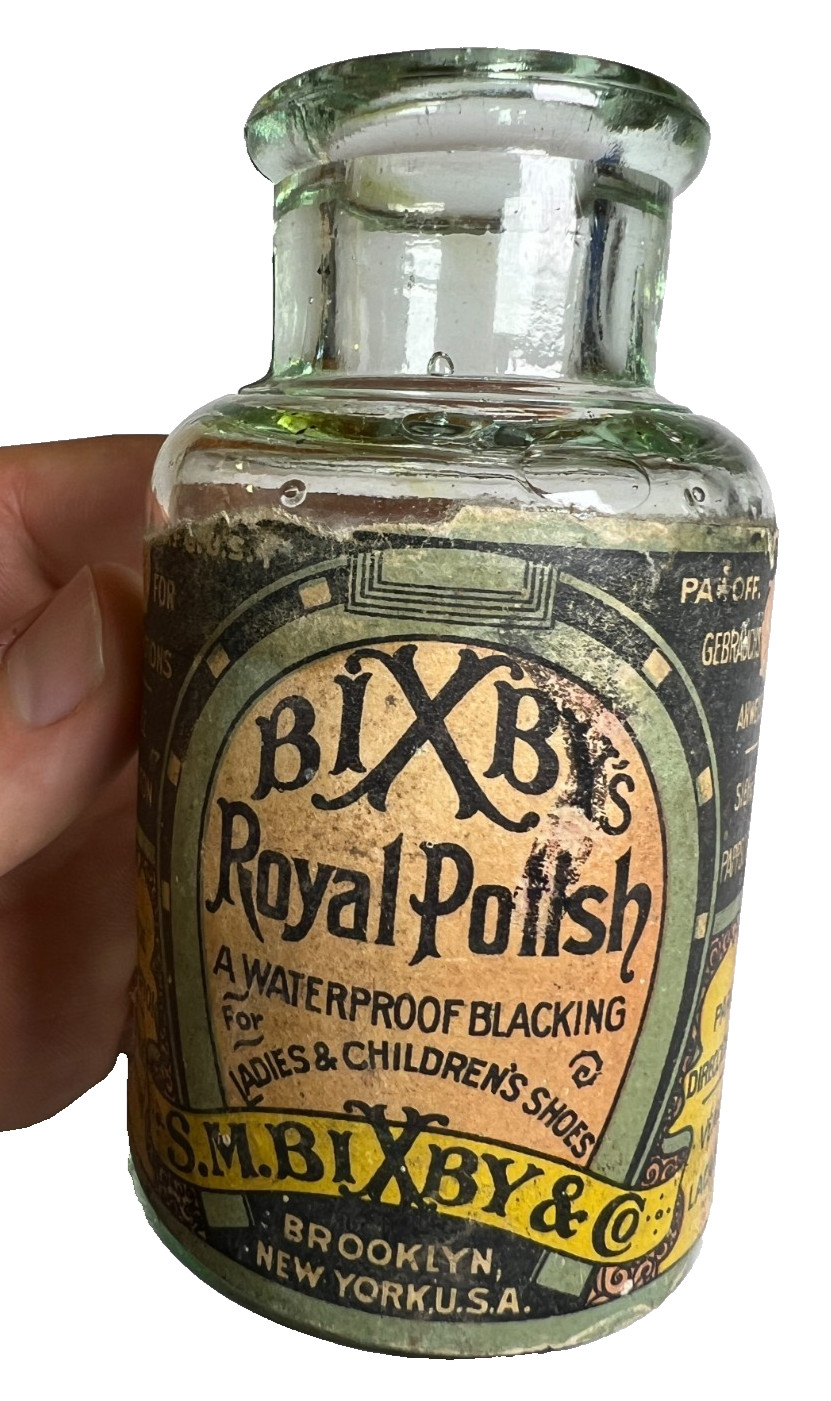
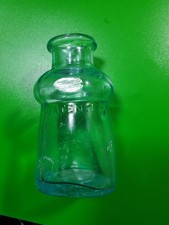
S. M. Bixby & Co. "Bixby's Royal Polish"
A Waterproof Blacking for Ladies' & Children's Shoes
Maker: S. M. Bixby & Co.
Location: Brooklyn, New York, U.S.A.
Precise Date
Based on the bottle style, applied paper label, multilingual export printing, and machine-made bottle with a broad prescription-style finish, I'd date this example to circa 1910–1918, with about 1912–1915 being the sweet spot.
Why?
- Machine-made bottle with early automatic bottle machine characteristics.
- Heavy rolled finish typical of the 1910s.
- Art Nouveau graphics that were popular just before and during WWI.
- Label printed in English, French, German, and Spanish, showing this was intended for international export.
What was "Royal Polish"?
This wasn't furniture polish.
It was a premium shoe blacking—a wax-based polish formulated to:
- restore black leather
- waterproof shoes
- nourish leather
- create a rich shine
Notice the label specifically says:
"For Ladies' & Children's Shoes."
Women's shoes around 1910 often featured delicate kid leather and finer calfskin that required softer formulations than heavy work-boot blacking.
The Company
S. M. Bixby & Co. was one of America's better-known shoe polish manufacturers during the late 1800s and early 1900s.
Their products competed with brands like:
- Whittemore's
- Griffin
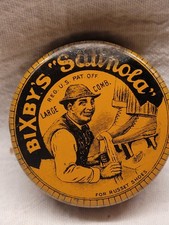
- Shinola (later)
- Gilt Edge
Bixby marketed itself as a premium polish, emphasizing appearance, waterproofing, and leather preservation.
The multilingual label shows they weren't simply selling locally—they were exporting worldwide.
Why the Label is Special
- olive green
- mustard yellow
- cream
- black
- ornate Art Nouveau borders
Even more interesting is the multilingual printing:
- English
- French
- German
- Spanish
Most surviving bottles lost their paper labels after years of handling. Finding one this complete is much harder.
ConditionExcellent
- No cracks
- No chips
- Strong original greenish-aqua glass
- Attractive bubbles in the glass
- Nice early machine-made character
- Excellent shoulder and lip
- 4" T
Honest Age
- Moderate label wear
- Small losses around edges
- Some rubbing to the center
Life in America When This Bottle Was Sold
Imagine stepping into a Brooklyn druggist or shoe store around 1913.
Horse-drawn wagons still rumbled down many streets, even as electric trolleys and automobiles began taking over.
Men commonly wore leather shoes every day.
Women owned only a handful of pairs of shoes—often expensive enough that maintaining them was expected rather than optional.
Children usually had one "good" pair reserved for church or school.
A bottle like this wasn't an impulse purchase.
It represented taking care of something valuable.
Families gathered around the kitchen after supper polishing tomorrow's shoes by lamplight.
Keeping leather clean wasn't just fashion—it protected an expensive investment.
Technology of the Era
When this bottle sat on store shelves:
- Ford's Model T was revolutionizing transportation.
- Airplanes had only recently become practical.
- Electric lighting was spreading but many homes still used gas lamps.
- Telephones existed, but long-distance calling was uncommon.
- Radio broadcasting to the public had not yet begun.
Medicine
Doctors still made house calls.
Antibiotics did not yet exist.
Small cuts could become dangerous infections.
Tuberculosis remained a major killer.
Horse-drawn ambulances still operated alongside early motor ambulances.
Politics
Depending on the exact year:
- Theodore Roosevelt's Progressive Era reforms were reshaping America.
- Woodrow Wilson entered the White House in 1913.
- World War I began in Europe in 1914.
- The United States entered the war in 1917.
Despite growing turmoil overseas, American manufacturers like S. M. Bixby were exporting products around the world—as your multilingual label proudly reflects.