When you click on links to various merchants on this site and make a purchase, this can result in this site earning a commission. Affiliate programs and affiliations include, but are not limited to, the eBay Partner Network.
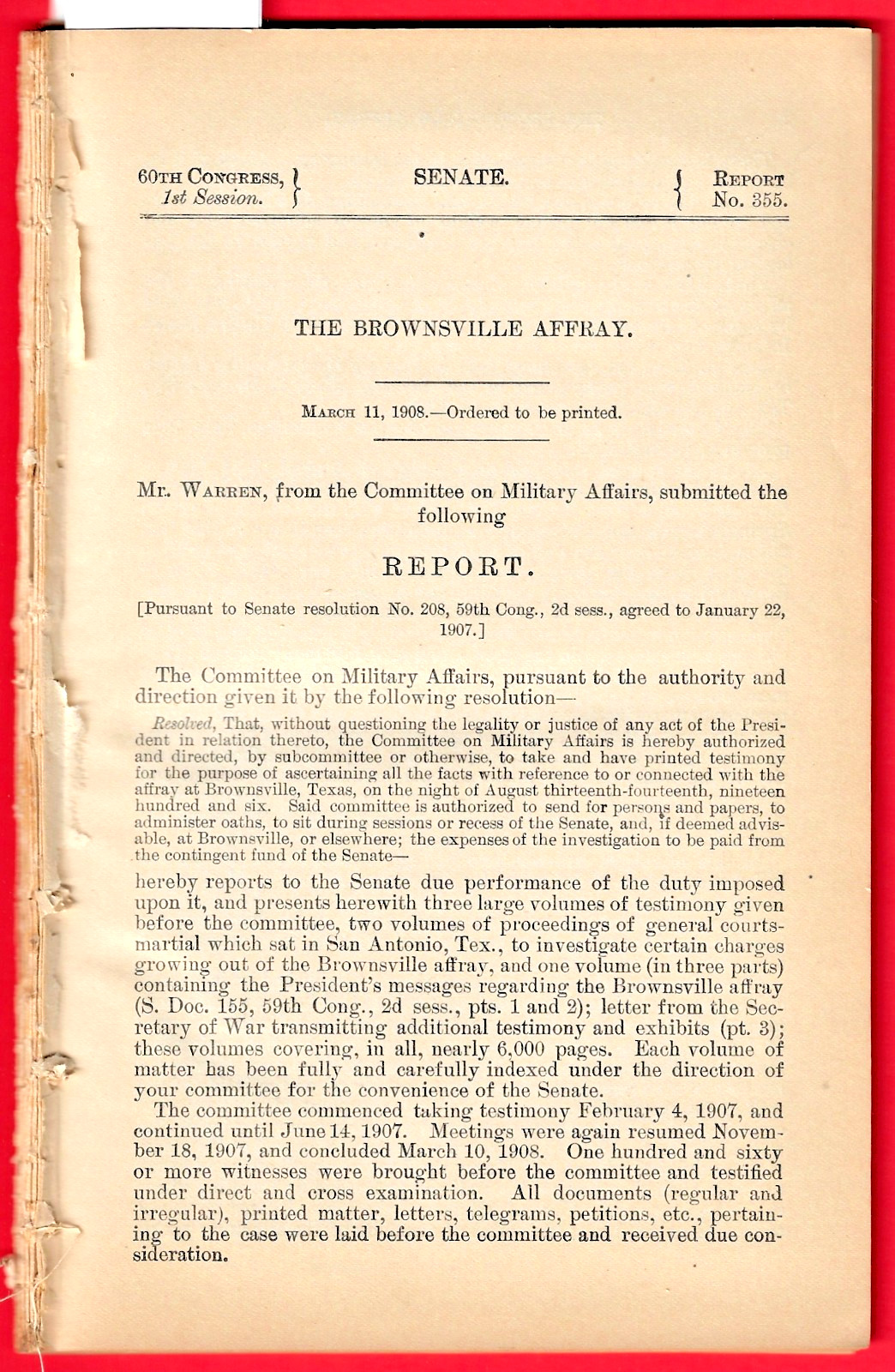
Senate Document number 355 (in 3 parts) plus Document number 446, from 1908. Total of 88 pages. Disbound from larger volume. Good condition.
Senate Document No. 355 from 1908 contains the U.S. Senate Committee on Military Affairs' official investigation into the 1906 Brownsville Affray. The March 11, 1908 report split into majority and minority findings regarding the unjust mass discharge of Black Buffalo Soldiers from the 25th Infantry.
Background and context of the Incident: On August 13–14, 1906, a shooting attack in Brownsville, Texas, killed a white bartender and wounded a police officer. The Accusation: Local white residents blamed Black soldiers stationed nearby. Despite a lack of direct proof and alibis from the men, President Theodore Roosevelt ordered the dishonorable discharge of 167 Black enlisted soldiers without a trial. The Investigation: The Senate Committee on Military Affairs gathered extensive testimony and hearings in 1908 to re-examine the dismissal. Key Findings of the Report Majority Report: Upheld the punitive action and President Roosevelt’s stance, claiming a "conspiracy of silence" protected the guilty soldiers within the battalion.
Minority Report: Strongly challenged the official stance and defended the soldiers, arguing that the evidence failed to prove the unit's collective guilt. Legacy: The minority findings championed by Senator Joseph Foraker laid the groundwork for historical correction. In 1972, the U.S. Army officially overturned the discharges, granting honorable discharges and full pardons.
Historical & Legal Value. As a piece of documentation, Document 355 is considered one of the most critical turning points in African-American military history. Preserving the Counter-Narrative: Its ultimate value lies in the minority report authored by Senators Joseph Foraker and Morgan Bulkeley. This text systematically dismantled the U.S. Army's flawed investigation and provided a permanent legal record defending the 167 falsely accused Buffalo Soldiers.
The Foundation for Justice: Though ignored by the executive branch for decades, this specific document preserved the vital testimonies and evidence used 64 years later. In 1972, it served as the historical bedrock that forced the U.S. Army to reverse the mass dishonorable discharges and issue pardons.
710 Our 27th year on