When you click on links to various merchants on this site and make a purchase, this can result in this site earning a commission. Affiliate programs and affiliations include, but are not limited to, the eBay Partner Network.
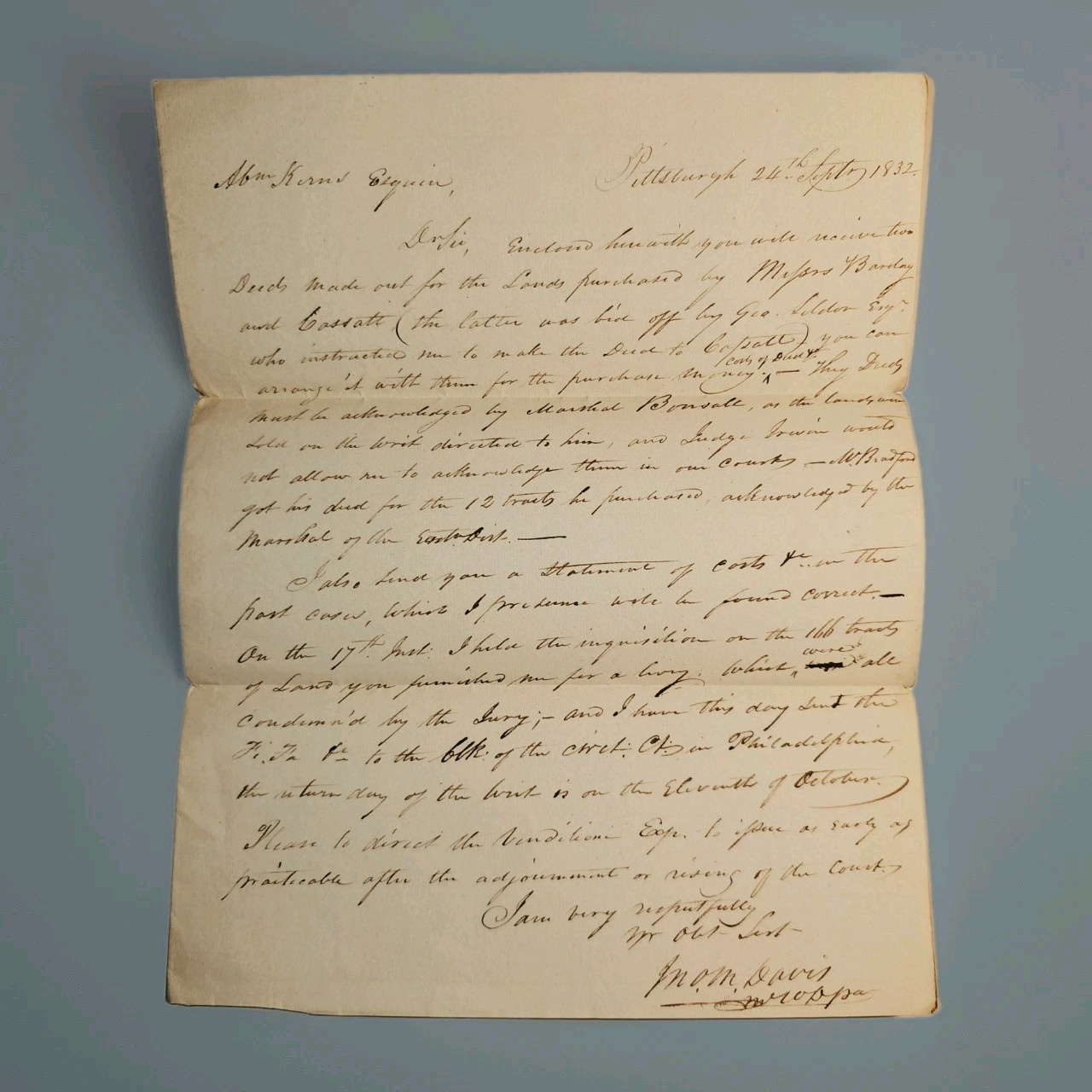
The letter concerns an unusually large federal land-execution proceeding involving 166 separate tracts of Pennsylvania land. Davis reports that he had conducted a formal jury inquisition on the property, that all 166 tracts had been “condemned” or found subject to execution, and that the necessary writs had been forwarded to the federal Circuit Court clerk in Philadelphia.
He also discusses deeds arising from earlier marshal’s sales, land purchased by individuals named Barclay, Cassatt and Bradford, and the need for deeds to be formally acknowledged by another federal marshal.
The sheet bears a visible “O & H” papermaker’s watermark, attributed to the important South Lee, Massachusetts partnership of Charles Owen and Thomas Hurlbut.
Historical Importance
This is a compelling example of how the early federal courts enforced judgments against landowners and speculators during the Jacksonian era.
The letter documents several stages of the federal execution process:
- Levy upon 166 tracts of land
- A jury inquisition held on September 17, 1832
- Condemnation of all 166 tracts
- Preparation and acknowledgment of marshal’s deeds
- Transmission of a fieri facias to Philadelphia
- A request for a venditioni exponas directing the sale of the condemned property
The sheer number of tracts involved makes this far more substantial than an ordinary deed, receipt or routine legal letter. It offers firsthand evidence of large-scale land litigation and federal property enforcement in early 19th-century Pennsylvania.
The document also directly mentions Judge Thomas Irwin, who had only recently received his permanent commission as federal judge for the Western District of Pennsylvania.
Transcription
Pittsburgh 24th Sept 1832
Abm Kerns Esquire,
Sir,
Enclosed herewith you will receive two Deeds made out for the Lands purchased by Messrs Barclay and Cassatt (the latter was offer off by Geo. Solder Esq. who instructed me to make the Deed to Cassatt) you can arrange it with them for the purchase money. The Deeds must be acknowledged by Marshal Bonsall, as the lands were sold on the writ directed to him, and Judge Irwin would not allow me to acknowledge them in our Court — Mr Bradford got his deed for the 12 tracts he purchased, acknowledged by the Marshal of the Eastern Dist. —
I also send you a statement of costs &c in the past cases, which I presume will be found correct. —
On the 17th Inst. I held the inquisition on the 166 tracts of Land you furnished me for a levy, which were all condemned by the Jury; — and I have this day sent the Fi. Fa. &c to the Clk. of the Circuit Ct in Philadelphia, the return day of the writ is on the Eleventh of October.
Please to direct the Venditioni Exp. to issue as early as practicable after the adjournment or rising of the Court.
I am very respectfully
Yr obt Servt
Jn. M. Davis
Marshal
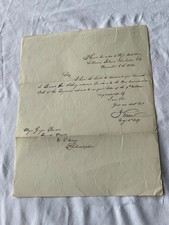
Address Panel
To
Abraham Kerns Esquire
Bedford
Pa.
Contemporary docketing reads approximately:
Marshal Davis
24 Sept. 1832
Legal Terms Explained
Fi. Fa. or fieri facias
A court-issued writ directing a marshal or sheriff to seize property belonging to a judgment debtor so that the property could be used to satisfy a debt.
Inquisition
A formal proceeding in which a jury examined or valued property that had been levied upon. In this letter, the jury determined that all 166 tracts were subject to execution.
Condemned
In this context, “condemned” does not mean that the land was unsafe. It means the jury found that the property could legally be taken and sold under the court’s judgment.
Venditioni exponas
A writ ordering the marshal to proceed with the sale of property that had already been seized or condemned under an earlier execution.
Biographical InformationJohn M. Davis, U.S. Marshal
John M. Davis was the presidentially appointed United States Marshal for the Western District of Pennsylvania. He entered the office in 1829 and remained marshal through much of the 1830s, until Seth Salisbury succeeded him in 1838. The official U.S. Marshals Service chronology confirms Davis’s service in the Western District during the period of this letter.
As U.S. Marshal, Davis was the principal enforcement officer of the federal courts in western Pennsylvania. His duties included serving federal writs, summoning jurors, taking custody of federal prisoners, levying upon property, conducting court-ordered sales and issuing deeds to successful purchasers.
This letter is particularly representative of his official work because it records nearly the full enforcement process, from levy and jury inquisition through preparation for the final sale of the land.
Judge Thomas Irwin
Thomas Irwin was appointed by President Andrew Jackson to the United States District Court for the Western District of Pennsylvania. He first received a recess appointment in April 1831, was nominated in December 1831 and was confirmed by the Senate on March 21, 1832, only six months before this letter was written. He remained on the federal bench until 1859.
Before becoming a federal judge, Irwin practiced law, served in the Pennsylvania House of Representatives and represented Pennsylvania in the United States Congress. His mention in the letter is significant because Davis states that Judge Irwin would not permit him to acknowledge certain deeds in the local court, requiring them instead to be acknowledged by the marshal to whom the original writ had been directed.
Abraham Kerns
The recipient, Abraham Kerns of Bedford, Pennsylvania, was evidently acting as an attorney, land agent, creditor or representative in the underlying proceedings. Davis states that Kerns had furnished the descriptions of the 166 tracts for the levy and asks him to arrange financial and procedural matters involving the purchasers.
Although the letter clearly establishes Kerns’s important role in the case, a definitive biography has not yet been established. His involvement with hundreds of tracts suggests experience in land litigation, debt collection or large Pennsylvania landholdings.
Marshal Bonsall
The letter states that the deeds had to be acknowledged by Marshal Bonsall because the lands had been sold under a writ directed to him. He was likely an officer associated with the Eastern District of Pennsylvania or the relevant federal process.
His precise identity should be considered unconfirmed pending comparison with contemporary federal court and marshal records.
Barclay, Cassatt, Bradford and George Solder
These individuals appear as purchasers, buyers or interested parties in the marshal’s land sales:
- Barclay and Cassatt were named as purchasers for whom deeds had been prepared.
- George Solder, Esquire, apparently offer on one property and instructed Davis to issue the deed to Cassatt.
- Mr. Bradford had purchased 12 tracts and had already obtained a deed acknowledged by the Marshal of the Eastern District.
The handwriting of these surnames is open to interpretation, and their full identities have not been conclusively established. Period spelling variations were common, so these names may appear differently in court dockets or recorded deeds.
O & H Watermark
The paper contains a clearly visible “O & H” watermark, associated with the early American papermaking partnership of Charles Owen and Thomas Hurlbut of South Lee, Massachusetts.
Owen and Hurlbut assumed management of Samuel Church’s paper mill in 1822 and became known for producing quality American writing, bond, letter and book papers. Surviving historical records specifically document Owen and Hurlbut watermarks, and the partnership’s history is fully consistent with the 1832 date of this letter.
The watermark is an attractive secondary feature that supports the period authenticity of the paper and adds interest for collectors of early American papermaking and watermarks.
Additional Pencil Notations
Faint pencil notes appear on portions of the reverse or interior folds. These appear to include rough measurements, room dimensions, windows, doors and possibly construction or architectural calculations.
They may have been added later when the sheet was reused as scrap paper and do not appear directly related to the federal land case.
Condition
Original folded manuscript letter with integral address panel.
The document displays:
- Expected age toning
- Original mailing and filing folds
- Small separation or loss at a fold intersection
- Minor edge wear
- Scattered marks and light staining
- Faint later pencil calculations
- Clear and generally legible principal text
- Visible O & H watermark when held to light
Please examine all photographs carefully, as they form an important part of the condition description.
Collector Appeal
An uncommon and highly detailed piece of early federal legal history connecting:
- John M. Davis, U.S. Marshal
- Judge Thomas Irwin
- Pittsburgh and Bedford, Pennsylvania
- The federal Circuit Court in Philadelphia
- Marshal’s sales and land speculation
- 166 condemned tracts of land
- Early American legal terminology
- Owen & Hurlbut watermarked paper
A strong acquisition for collectors of Pennsylvania history, Pittsburgh history, Bedford County, federal courts, U.S. Marshals, early American law, land speculation, manuscripts or historic watermarks.