When you click on links to various merchants on this site and make a purchase, this can result in this site earning a commission. Affiliate programs and affiliations include, but are not limited to, the eBay Partner Network.
Ever wonder why a beer company would bother printing a joke on a piece of wood cut to look like a coin?🪙
There\'s a particular kind of American charm packed into a token like this one — the kind that only makes sense once you remember how much of mid-century advertising ran on a wink and a laugh rather than a hard sell. Long before punch cards, coupon apps, or QR codes, a tavern keep, a brewery rep, or a county fair booth would press a little wooden disc into your palm, and you\'d grin because you already knew the gag. \"Don\'t take any wooden nickels\" had been American slang for decades by the time breweries started printing the phrase directly onto actual wooden nickels — turning the warning itself into the punchline.This piece belongs to that tradition, and it\'s the kind of small, story-rich object that collectors of old tavern culture and breweriana go looking for precisely because it says so much in so little space.
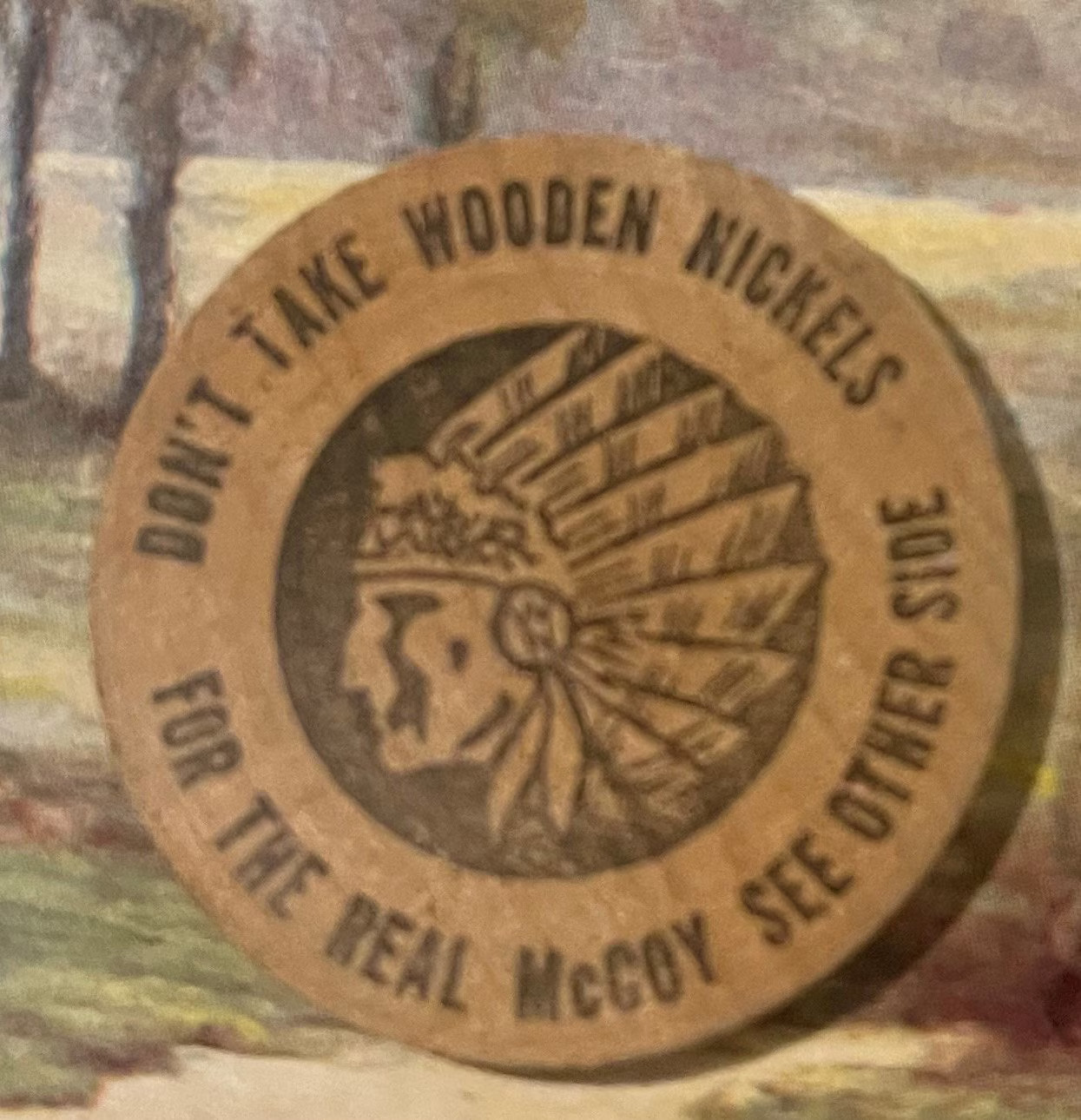
What you\'re looking at is a vintage Schlitz Malt Liquor wooden nickel, a giveaway token from the Joseph Schlitz Brewing Company of Milwaukee, Wisconsin — one of the true giants of American brewing.This is New Old Stock (NOS), a genuine survivor from an advertising tradition that ran strong through the mid-20th century, roughly the 1950s through the 1970s, when breweries, taverns, and civic groups across the country handed these out by the handful. The token measures a true 1.5 inches (38mm) in diameter — a compact, coin-shaped wooden disc, sized and weighted to sit in a shirt pocket or a cigar box exactly the way a real coin would.The design pairs Schlitz\'s malt liquor branding with the classic wooden-nickel joke that made these things collectible in the first place: a profile portrait of a Native American chief in a full, radiating feathered headdress, ringed by the lettering DON\'T TAKE WOODEN NICKELS — FOR THE REAL McCOY SEE OTHER SIDE, alongside the Schlitz name set above a bold, stylized bull\'s-head emblem — the mark the brewery used to set its malt liquor line apart from its standard beer.The lettering is bold, blocky, and confidently arced around the coin\'s circumference, the chief\'s portrait carved in the same graphic tradition as the era\'s most famous circulating coinage, and the whole thing carries the warm, dry-grain tone that only real wood takes on.
🍺 The Company Behind the Bull: Joseph Schlitz Brewing Co.
The Schlitz story starts in 1849, when a German immigrant named August Krug opened a small restaurant and brewery in Milwaukee, on what\'s now Juneau Avenue between Fourth and Fifth Streets.Milwaukee at that time was filling up fast with German immigrants who brought serious brewing know-how with them, and Krug\'s little operation was one of dozens competing for a thirsty, rapidly growing city. In 1850, Krug hired a young bookkeeper newly arrived from Mainz, Germany — a sharp, hardworking man named Joseph Schlitz.When Krug died in 1856, Schlitz took over running the brewery, and in 1858 he married Krug\'s widow, cementing his hold on the company that would soon carry his name.
Schlitz built the business methodically, but the moment that truly put the brewery on the national map came in 1871, when the Great Chicago Fire leveled much of that city — including most of its own breweries.Schlitz shipped beer south to a desperate, thirsty Chicago in its hour of need, and the gesture stuck in the public memory for generations. It\'s part of the lore behind the brewery\'s famous slogan, \"The beer that made Milwaukee famous\" — a line that turned a hometown brewery into a national household name.By 1902, Joseph Schlitz Brewing Company had become the largest brewer in the United States, a title it would trade back and forth with Anheuser-Busch of St. Louis for decades. In bars from Green Bay to New Orleans to San Francisco, the Schlitz name meant something — it meant Milwaukee, it meant German brewing craft transplanted onto American soil, and it meant a beer serious drinkers trusted.
The Malt Liquor line pictured on this very token was Schlitz\'s bolder sibling to its standard beer — a stronger, more assertive brew built for drinkers who wanted more kick in the glass.Malt liquor as a category carved out its own identity in American brewing in the decades after Prohibition and through the postwar years, marketed with a swagger that regular lager didn\'t need, and the bull\'s-head emblem on this token was part of that distinct visual identity — a mark meant to stand apart on a bar shelf crowded with competitors.
🏙️ Milwaukee: Beer City, U.S.A.
You can\'t tell the Schlitz story without telling Milwaukee\'s.By the late 19th century, the city had become one of the true capitals of American brewing, home not just to Schlitz but to Pabst, Miller, and Blatz — the so-called \"Big Four\" whose smokestacks and delivery wagons defined the Milwaukee skyline and economy for generations. German immigrant brewing families built entire neighborhoods around their breweries, and the industry became so central to the city\'s identity that \"Milwaukee\" and \"beer\" were practically synonyms in the American vocabulary for the better part of a century.Old-timers around Milwaukee still talk about the days when brewery whistles marked the rhythm of the workday almost as reliably as church bells, and when a Schlitz delivery truck rolling down the street was as familiar a sight as the streetcar.
🦬 An Old Joke Wearing an Older Face
The phrase \"don\'t take any wooden nickels\" was already common American slang, a folksy warning against being cheated or fooled, well before anyone thought to literally carve it onto wood.Lore passed down among token collectors traces the birth of actual wooden money to a real 1930s emergency: when a bank failure left the small town of Tenino, Washington without functioning currency, the local Chamber of Commerce issued wooden scrip so residents could keep doing business — an honest-to-goodness circulating wooden currency, born of Depression-era necessity rather than novelty.Collectors credit that moment as the spark that gave the format its name and its legend. In the years that followed, the format shifted from emergency currency to pure advertising fun — Chambers of Commerce, county fairs, restaurants, and breweries all discovered that a wooden \"coin\" was a cheap, memorable, pocket-sized way to plant a name in a customer\'s mind, and the built-in joke of the phrase made every one of them a tiny piece of theater.
The chief\'s portrait wasn\'t chosen at random, either.It directly echoes the Indian Head (Buffalo) nickel, minted by the U.S. Treasury from 1913 to 1938 and instantly recognizable to anyone who\'d ever handled real American change. Putting a near-twin of that famous profile on a piece of wood was the whole gag — a fake nickel dressed up exactly like the real thing, daring you to look twice.And the phrase \"for the real McCoy\" tucked into the design carries its own tangle of American folklore — old-timers differ on whether it traces back to a Scotch whisky brand insisting on its own authenticity or to a scrappy early prizefighter nicknamed \"Kid McCoy\" who wanted people to know he was the genuine article and not an impersonator.Either way, by the time it landed on a wooden nickel, \"the real McCoy\" had long since become shorthand for the genuine thing — a perfect closing line for a token built entirely around a joke about fakery.
📈 Breweriana Today
Pieces like this one survive today as small, sturdy fragments of American tavern culture — a world of neighborhood bars, brewery giveaways, and civic boosterism that\'s largely faded from daily life but is very much alive in the breweriana collecting world.Schlitz itself, once the undisputed heavyweight of American brewing, has become as much a piece of history as a product on a shelf, which only sharpens the appeal of anything carrying its name and mark. A wooden nickel like this one packs the brewery\'s branding, the Indian Head coin joke, and a slice of small-town American commerce history into a single object you can hold in one hand — which is exactly why collectors chase them down.
🖼️ Display Ideas
- 🪙 Set it upright in a small coin or token stand alongside other breweriana pieces for a mini \"bar wall\" display.
- 🖼️ Shadow-box it with a vintage Schlitz ad, tap handle, or coaster for a themed collector frame.
- 🍺 Tuck it into a home bar or man-cave shelf as a conversation-starting piece of tavern history.
- 📚 Add it to a broader wooden nickel or exonumia collection sorted by brewery, era, or region.
- 🎁 Give it to a Milwaukee native, Schlitz collector, or breweriana enthusiast as a pocket-sized piece of hometown pride.
- 🪶 Pair it with Native American-motif coin or currency pieces to showcase the Indian Head design tradition across different collectible categories.
🎁 Who Collects These
Wooden nickels like this one draw a wide range of collectors: breweriana specialists chasing anything with a Schlitz mark, exonumia and token collectors who focus on advertising and novelty coinage broadly, Milwaukee and Wisconsin regional history buffs, and old-school Americana lovers who simply enjoy the graphic style of the Indian Head design and the folksy humor baked into the phrase.Bar and restaurant owners furnishing a vintage-style tavern space often look for pieces exactly like this one to scatter across shelves and displays, and it\'s a natural, easy gift for anyone who grew up with a grandfather\'s or father\'s old tavern stories about Schlitz on tap.
❓ FAQWhat does \"Don\'t Take Wooden Nickels\" actually mean?
It\'s an old American saying warning against being cheated or fooled — essentially \"don\'t get taken.\" Businesses turned the phrase into a literal joke by printing it onto actual wooden discs shaped like coins, which is exactly what you see here.
Why does a beer token show a Native American chief instead of just the Schlitz logo?
The chief\'s profile is a deliberate echo of the U.S.Indian Head (Buffalo) nickel that circulated in American pocket change for decades. Mimicking that familiar design was the whole point of the gag — a \"fake\" nickel dressed up to look just like the real one.
Is this an actual coin, or just a novelty?
It\'s a novelty advertising token, not legal currency — it was never meant to be spent, only handed out as a memorable branded keepsake.
How big is the token?
It measures 1.5 inches (38mm) across, a genuine pocket-sized coin shape.
What was Schlitz Malt Liquor, and how did it differ from regular Schlitz beer?
Malt liquor was Schlitz\'s stronger, bolder product line, marketed separately from its standard lager and branded with its own distinct bull\'s-head mark, as seen on this token.
What condition is this piece in?
This is New Old Stock (NOS) — genuine unused inventory from its original advertising run, with crisp, legible printing and the natural warm grain that gives real wooden tokens their character.
Where would something like this originally have been handed out?
Tokens like this were classic bar-top and tavern giveaways, distributed by breweries and retailers to promote a product or simply build goodwill and a laugh at the counter — small, cheap advertising with an outsized sense of fun.