When you click on links to various merchants on this site and make a purchase, this can result in this site earning a commission. Affiliate programs and affiliations include, but are not limited to, the eBay Partner Network.
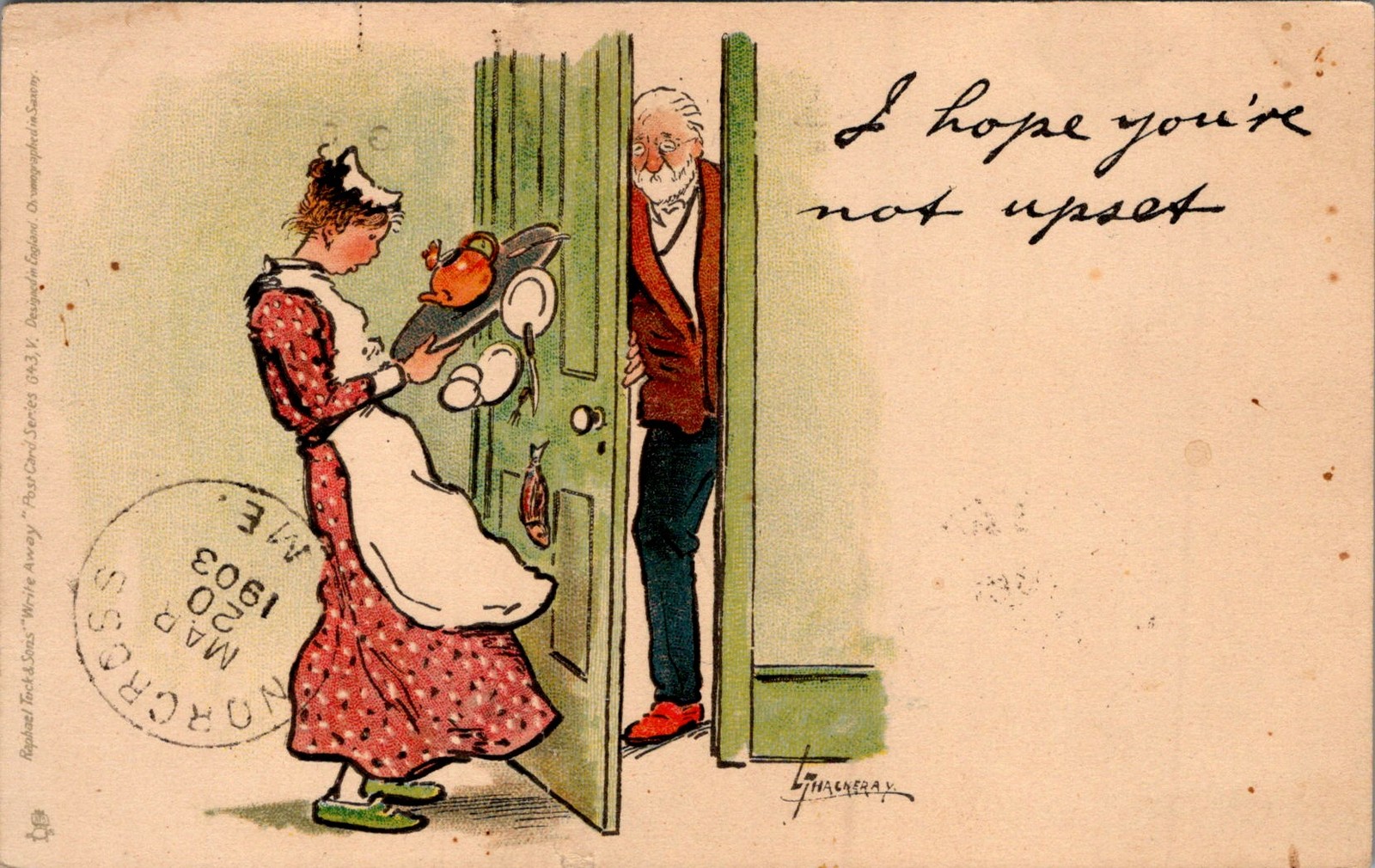
This Raphael Tuck & Sons \"Write Away\" Series 643.V postcard features a comic illustration by L. Thackeray depicting a domestic mishap: a maid in a polka-dot dress and white apron drops a tray laden with a teapot, plates, and eggs, while an older gentleman peers from a doorway with an expression of surprise or mild dismay. The card bears the printed notation \"Designed in England. Chromographed in Saxony,\" reflecting the transnational production model common to the Golden Age of postcards, in which British publishers commissioned chromolithographic printing from German workshops in Saxony renowned for their color reproduction fidelity. The divided-back format, however, is absent here; this is an undivided-back card, meaning the entire verso was reserved for the address, and the sender\'s handwritten message appears on the front picture side. That message, inscribed near the top right, reads \"I hope you\'re not upset,\" a wry caption that interacts directly with the visual narrative of breakage and domestic disaster.The card was postmarked in Bangor, Maine, on March 19, 1903, at 12 PM, and addressed to Mr. Guy C. Haynes in Norcross, Maine. A second postmark from Norcross, Maine, dated March 20, 1903, confirms delivery. Norcross is a village in the town of Lagrange, Penobscot County, Maine. The one-cent Benjamin Franklin stamp, affixed to the upper right of the verso, was the standard United States postcard rate at the time. The verso also features a decorative crest resembling a stylized British Royal Coat of Arms with lion and unicorn supporters, a common ornamental device on early twentieth-century postcards. Condition notes indicate overall toning and yellowing consistent with age, scattered foxing and brown spotting, minor edge and corner wear, and a faint vertical crease running down the center of the verso through the \"POST CARD\" text. The chromolithographic colors on the front remain relatively vibrant despite the card\'s 120-plus years.